

AI Replacing Jobs: 20 Careers Changing Faster Than Experts Predicted (2026)
AI replacing jobs has become one of the biggest workplace discussions in 2026. Artificial intelligence (AI) is no longer just a futuristic concept—it is already transforming businesses across the world. From customer service to software development, businesses are rapidly adopting AI-powered tools to automate routine tasks, improve efficiency, and reduce operating costs. As a result, many people are asking the same question: Is AI replacing jobs?
The answer is both yes and no. AI is replacing some tasks and reducing demand for certain roles, while also creating entirely new career opportunities. The biggest impact is often on repetitive or predictable work, whereas jobs requiring creativity, leadership, complex decision-making, and interpersonal skills remain more resilient.
According to recent reports from major organizations including the World Economic Forum, the International Monetary Fund, and leading consulting firms, millions of workers worldwide will need to adapt their skills over the coming years as AI becomes a standard part of business operations.
If you’re wondering how to stay competitive, you may also like our guide on Best AI Tools for Students: 20 Free and Paid Options in 2026, which highlights practical tools for learning AI skills.
In this article, we explore 20 jobs that AI is replacing or reshaping faster than many experts predicted, why these changes are happening, and what workers can do to remain competitive in the evolving job market.

1. Customer Service Representatives
One of the first industries to experience widespread AI adoption has been customer service.
AI-powered chatbots and virtual assistants can now answer common questions, process refunds, schedule appointments, and even troubleshoot technical issues around the clock. Businesses benefit from reduced costs and faster response times, while customers often receive immediate assistance.
This does not mean customer service jobs will disappear entirely. Instead, many companies are shifting human agents toward handling complex complaints, sensitive situations, and cases requiring empathy or nuanced judgment.
Why AI is changing this job
- 24/7 availability
- Lower operating costs
- Faster response times
- Ability to handle thousands of conversations simultaneously
Skills that remain valuable
- Conflict resolution
- Emotional intelligence
- Complex problem-solving
- Customer relationship management

2. Data Entry Clerks
Data entry has long been considered one of the most repetitive office jobs, making it especially suitable for automation.
Modern AI systems can extract information from invoices, forms, emails, and scanned documents with impressive accuracy. Optical character recognition (OCR) combined with machine learning significantly reduces the need for manual data input.
Many organizations now use intelligent document processing software to complete tasks that once required entire teams of data entry specialists.
Tasks increasingly automated
- Invoice processing
- Form completion
- Database updates
- Record management
- Document categorization
Workers with skills in data analysis, quality assurance, or database management are often better positioned as these technologies become more widespread.
3. Transcriptionists
Speech recognition technology has improved dramatically over the past few years.
AI transcription platforms can convert recorded meetings, interviews, podcasts, and lectures into text within minutes. Businesses, journalists, students, and legal professionals increasingly rely on automated transcription services for speed and affordability.
However, human transcriptionists remain important when recordings involve multiple speakers, heavy accents, poor audio quality, or legal proceedings where high accuracy is essential.
AI advantages
- Faster turnaround
- Lower costs
- Real-time transcription
- Automatic translation features
Human strengths
- Context understanding
- Editing accuracy
- Legal compliance
- Quality assurance
4. Bookkeepers
Small businesses are increasingly adopting AI-powered accounting software capable of automatically categorizing expenses, generating invoices, reconciling bank transactions, and producing financial reports.
Routine bookkeeping tasks that once required hours of manual work can now be completed within minutes.
Professional accountants are not disappearing, but their roles are evolving toward financial strategy, auditing, tax planning, compliance, and business advisory services.
Many small businesses are already using affordable AI software to automate accounting and administrative tasks. If you own a business, our article Best AI Tools for Small Businesses in 2026 (Tested & Ranked) explores some of the most effective solutions available today.
Tasks becoming automated
- Expense categorization
- Receipt scanning
- Invoice generation
- Bank reconciliation
- Payroll calculations
Professionals who understand both accounting principles and financial technology are expected to remain in high demand.
5. Content Writers (Routine Content)
This may surprise many readers.
Generative AI tools can now produce product descriptions, marketing emails, social media captions, summaries, and basic news reports within seconds.
As a result, businesses are using AI to accelerate content production, particularly for repetitive or formulaic writing tasks.
However, AI has not replaced skilled human writers.
High-quality journalism, investigative reporting, opinion pieces, expert analysis, storytelling, and SEO-focused content still require human expertise. Search engines also continue to emphasize original, helpful, people-first content rather than mass-produced, low-value material.
The writers most likely to thrive are those who combine AI tools with strong research, critical thinking, subject expertise, and editorial judgment.
Writing tasks AI handles well
- Product descriptions
- Meta descriptions
- Social media drafts
- Email templates
- Basic summaries
Writing tasks where humans still excel
- Investigative journalism
- In-depth analysis
- Interviews
- Original reporting
- Brand storytelling
- Expert opinion pieces
Writers, marketers, and freelancers can also improve productivity using the tools featured in AI Tools: 25 Best Free Apps That Save Hours in 2026.
Why AI Replacing Jobs Matters to Every Worker
The rise of AI is changing the workplace faster than many expected, but history suggests technological revolutions often transform jobs rather than eliminate work. Workers who continuously learn new skills, adapt to new technologies, and focus on uniquely human capabilities are likely to remain competitive.
In the next section, we’ll look at five more professions experiencing rapid AI-driven change, including graphic design, software development, translation, market research, and legal support.
Part 2: Jobs 6–10
The debate over AI replacing jobs continues as creative industries increasingly adopt AI to automate repetitive tasks. In many cases, AI is not replacing entire professions but is automating routine tasks, allowing businesses to do more with smaller teams.
Here are five more jobs experiencing significant change in 2026.

6. Graphic Designers
AI-powered image generators and design assistants have transformed how businesses create visual content. Marketing teams can now generate social media graphics, advertisements, logos, and presentation slides in minutes instead of hours.
This has reduced demand for designers who primarily produce simple, repetitive graphics.
However, experienced graphic designers remain highly valuable for projects requiring creativity, branding, user experience, and strategic thinking.
Tasks AI can perform
- Social media graphics
- Marketing banners
- Basic logos
- Product mockups
- Image editing
- Background removal
Skills that remain in demand
- Brand identity development
- User interface (UI) design
- User experience (UX) design
- Creative direction
- Motion graphics
- Professional illustration
Career Tip: Designers who learn to use AI as part of their workflow can often complete projects faster while focusing on high-value creative work.
7. Junior Software Developers
One of the biggest surprises of 2026 has been how quickly AI coding assistants have improved.
Modern AI tools can write code, explain programming concepts, detect bugs, generate documentation, and even create complete applications from natural language prompts.
This doesn’t mean software engineers are disappearing.
Instead, companies increasingly expect developers to supervise AI-generated code, review security issues, optimize performance, and build complex systems rather than write every line manually.
Programming tasks AI handles well
- Code generation
- Debugging suggestions
- Unit tests
- Documentation
- Code translation between languages
- Simple web applications
Human developers remain essential for
- Software architecture
- Security
- System design
- Performance optimization
- Client requirements
- Quality assurance
Many employers now value developers who know how to work efficiently with AI tools instead of avoiding them.
Many of today’s AI coding assistants are included in our roundup of AI Tools: 25 Best Free Apps That Save Hours in 2026, making them worth exploring for developers and beginners alike.
8. Translators
Machine translation has become remarkably accurate for many everyday situations.
Businesses, travelers, and international organizations increasingly rely on AI-powered translation tools to communicate across languages instantly.
Routine translations of emails, websites, manuals, and customer support messages can often be completed automatically.
However, human translators continue to play an important role in areas where precision and cultural understanding matter.
AI performs well with
- Business emails
- Website translation
- Product descriptions
- User manuals
- Travel communication
Human translators remain essential for
- Legal documents
- Medical records
- Literature
- Marketing campaigns
- Diplomatic communication
- Cultural adaptation
Language professionals who specialize in localization, editing, or multilingual consulting are expected to remain competitive.
9. Market Research Analysts
Businesses increasingly use AI to collect, organize, and analyze enormous amounts of customer data.
Instead of manually reviewing surveys and spreadsheets, analysts can now receive automated insights within minutes.
AI tools help companies identify trends, predict customer behavior, analyze online reviews, and generate reports much faster than traditional methods.
Tasks AI now performs
- Survey analysis
- Customer segmentation
- Trend identification
- Sales forecasting
- Competitor monitoring
- Data visualization
Human expertise still matters for
- Business strategy
- Interpreting results
- Consumer psychology
- Decision-making
- Ethical considerations
- Executive presentations
Organizations still rely on experienced analysts to turn AI-generated insights into business decisions.
10. Paralegals and Legal Assistants
Artificial intelligence is increasingly helping law firms manage documents, conduct legal research, summarize contracts, and organize case files.
Tasks that once required hours of manual review can often be completed in minutes using AI-powered legal software.
However, legal professionals emphasize that AI cannot replace licensed attorneys or human judgment in legal practice.
Legal tasks AI assists with
- Contract review
- Document summarization
- Legal research
- Case organization
- Discovery support
- Deadline tracking
Human professionals remain responsible for
- Court representation
- Legal advice
- Client communication
- Negotiation
- Ethical decisions
- Complex litigation
Rather than replacing legal teams, AI is changing how law firms allocate their time and resources.
AI Is Transforming Jobs—Not Just Eliminating Them
One of the biggest misconceptions about artificial intelligence is that it simply “takes jobs.”
In reality, AI often automates repetitive tasks while creating demand for new skills. Many professionals are discovering that learning how to work alongside AI can increase productivity and open new career opportunities.
The workers most likely to succeed in the coming years are those who embrace continuous learning, strengthen uniquely human skills such as creativity and critical thinking, and use AI as a productivity tool rather than viewing it only as a competitor.
Part 3: Jobs 11–15
Financial services provide another example of AI replacing jobs, particularly where routine analysis and reporting can be automated. In 2026, AI is helping businesses make decisions, predict trends, generate content, and improve customer experiences. While this creates new opportunities, it also means professionals in many industries must adapt their skills to stay competitive.
Here are five more jobs being significantly reshaped by AI.

11. Financial Analysts
AI has become a powerful tool in the financial sector. Banks, investment firms, and corporations use AI to process vast amounts of market data, identify trends, assess risks, and generate financial forecasts in seconds.
Tasks that once took analysts days to complete can now be performed almost instantly.
However, AI cannot replace experienced professionals who understand market psychology, economic conditions, regulatory requirements, and business strategy.
Tasks AI performs well
- Financial forecasting
- Portfolio analysis
- Risk assessment
- Fraud detection
- Market trend analysis
- Automated reporting
Human expertise remains essential for
- Investment strategy
- Client advisory services
- Economic interpretation
- Business negotiations
- Regulatory compliance
- High-level decision-making
Career Tip: Financial professionals who combine data analytics, AI literacy, and strategic thinking are likely to remain highly sought after.
12. Travel Agents
The travel industry has changed dramatically thanks to AI-powered booking platforms and virtual travel assistants.
Today’s AI systems can compare thousands of flights, hotels, rental cars, and travel packages within seconds while recommending personalized itineraries based on a traveler’s budget and preferences.
Many travelers now plan entire vacations without speaking to a human agent.
Tasks AI now handles
- Flight comparisons
- Hotel recommendations
- Trip planning
- Price monitoring
- Travel alerts
- Visa information guidance
Human travel advisors still provide value through
- Luxury travel planning
- Group travel coordination
- Complex international itineraries
- Emergency travel support
- Personalized recommendations
- Destination expertise
Travel professionals who specialize in customized experiences and premium services continue to attract clients despite increasing automation.
13. Retail Cashiers
Self-checkout systems have existed for years, but AI is making them much smarter.
Many retailers now use AI-powered checkout systems that recognize products automatically, detect fraud, monitor inventory in real time, and reduce waiting times.
Some stores are even experimenting with checkout-free shopping, where customers simply pick up items and leave while AI calculates the bill automatically.
Retail tasks increasingly automated
- Barcode scanning
- Payment processing
- Inventory updates
- Price verification
- Loyalty rewards
- Receipt generation
Human employees remain important for
- Customer assistance
- Product recommendations
- Problem resolution
- Store management
- Sales consultations
- Security oversight
Retail workers who develop customer service and management skills are likely to have stronger long-term career prospects.
14. Journalists (Routine Reporting)
Artificial intelligence has become a valuable tool in modern newsrooms.
Many media organizations now use AI to draft earnings reports, sports summaries, weather updates, election results, and breaking news alerts based on structured data.
However, AI has not replaced investigative journalism or original reporting.
Readers continue to value human journalists who conduct interviews, verify facts, uncover exclusive stories, and provide meaningful context.
Tasks AI performs effectively
- Sports score summaries
- Financial earnings reports
- Weather updates
- News summaries
- Headline suggestions
- Article transcription
Journalism still requires humans for
- Investigative reporting
- Interviews
- Fact-checking
- Political analysis
- War reporting
- Ethical decision-making
For news publishers, AI is increasingly used to assist journalists—not replace them. Editorial oversight remains essential to ensure accuracy, fairness, and credibility.
15. Recruiters
Recruitment has become significantly more automated with the rise of AI-powered hiring platforms.
Many companies now use AI to screen resumes, rank candidates, schedule interviews, and identify applicants whose skills best match job descriptions.
This reduces administrative work and speeds up hiring, especially for organizations receiving thousands of applications.
However, successful hiring still depends heavily on human judgment.
Learning how to use AI effectively can also open opportunities in remote work. Check out Remote Jobs No Experience: 15 Companies Hiring in July 2026 to discover companies embracing digital-first hiring.
Recruitment tasks AI handles
- Resume screening
- Candidate ranking
- Skills matching
- Interview scheduling
- Job description generation
- Applicant tracking
Human recruiters remain responsible for
- Final interviews
- Cultural fit assessments
- Salary negotiations
- Relationship building
- Executive hiring
- Diversity and inclusion initiatives
Recruiters who focus on strategic talent acquisition and employee relationships continue to play a vital role in organizations.
The Biggest Workplace Shift Isn’t Job Loss—It’s Skill Transformation
One of the most important lessons from the AI revolution is that technology rarely eliminates all jobs within a profession overnight. Instead, it changes how work is performed.
Employees who embrace AI as a productivity tool often become more efficient, while those who continuously update their skills are better positioned for new opportunities.
Experts increasingly recommend developing capabilities that AI struggles to replicate, including:
- Critical thinking
- Leadership
- Creativity
- Emotional intelligence
- Communication
- Strategic decision-making
- Complex problem-solving
- Ethical judgment
These human-centered skills are expected to remain valuable across industries, even as AI becomes more capable.
Part 4: Jobs 16–20, Careers Growing Because of AI, FAQs & Conclusion
Artificial intelligence is expected to continue transforming industries throughout the coming decade. While some jobs are becoming more automated, new opportunities are emerging for workers who develop the right skills.
Manufacturing and logistics clearly demonstrate how AI replacing jobs is reshaping industries around the world.
Let’s look at the final five occupations being significantly reshaped by AI.
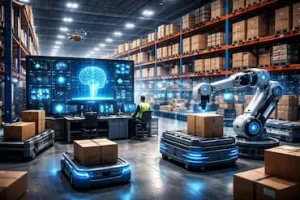
16. Warehouse Workers
Modern warehouses are becoming increasingly automated with AI-powered robots, autonomous forklifts, and smart inventory management systems.
Large logistics companies use AI to optimize storage locations, predict demand, manage inventory, and guide robotic picking systems.
Tasks AI and robotics now perform
- Inventory tracking
- Package sorting
- Route optimization
- Order picking assistance
- Stock monitoring
- Demand forecasting
Human workers remain essential for
- Equipment maintenance
- Safety supervision
- Quality control
- Complex logistics planning
- Warehouse management
- Exception handling
As warehouses become smarter, workers with technical and supervisory skills are likely to be in greater demand.
17. Manufacturing Assembly Workers
Factories have used automation for decades, but AI is making production lines more intelligent than ever.
AI-powered machines can monitor quality, detect defects, predict maintenance needs, and optimize production schedules with minimal human intervention.
AI is improving
- Product inspection
- Machine monitoring
- Quality assurance
- Predictive maintenance
- Production scheduling
- Supply chain forecasting
Humans still provide
- Equipment repair
- Engineering oversight
- Process improvement
- Safety management
- Innovation
- Production planning
Workers who learn robotics, industrial automation, or maintenance technologies may find expanding career opportunities.
18. Telemarketers
Telemarketing has been one of the occupations most affected by AI.
Voice assistants and conversational AI can now answer questions, qualify leads, schedule appointments, and provide product information around the clock.
Businesses benefit from lower costs and the ability to handle a much larger number of customer interactions.
AI handles
- Outbound calls
- Appointment scheduling
- Frequently asked questions
- Lead qualification
- Customer follow-ups
- Basic sales conversations
Humans remain valuable for
- Complex negotiations
- Enterprise sales
- Relationship management
- High-value customers
- Strategic partnerships
- Closing major deals
Sales professionals who focus on consultative selling and long-term client relationships continue to be highly valued.
19. Proofreaders and Copy Editors
Grammar correction and editing tools have become remarkably sophisticated.
AI can now identify spelling mistakes, grammar issues, awkward phrasing, readability concerns, and style inconsistencies within seconds.
However, editing extends far beyond correcting grammar.
AI performs well
- Grammar checking
- Spelling correction
- Style suggestions
- Readability improvements
- Basic formatting
- Consistency checks
Human editors remain indispensable for
- Fact-checking
- Editorial judgment
- Tone and voice
- Legal review
- Publishing standards
- Narrative flow
Professional editors continue to play a crucial role in journalism, publishing, academic research, and corporate communications.
20. Loan Officers
Banks increasingly rely on AI to process loan applications, verify documents, detect fraud, and assess credit risk.
Many consumer loans can now receive preliminary decisions within minutes.
AI automates
- Credit scoring
- Document verification
- Fraud detection
- Income analysis
- Risk assessment
- Application processing
Human loan officers remain important for
- Complex lending decisions
- Mortgage consultations
- Business financing
- Regulatory compliance
- Customer relationships
- Financial advice
AI speeds up routine lending processes, but experienced financial professionals remain essential for cases requiring judgment and personalized guidance.
New Careers Emerging Despite AI Replacing Jobs

Although much attention focuses on jobs being automated, AI is also creating entirely new career opportunities.
Some of the fastest-growing roles include:
- AI Engineers
- Machine Learning Engineers
- Prompt Engineers
- AI Product Managers
- AI Ethics Specialists
- Cybersecurity Analysts
- Data Scientists
- Robotics Engineers
- Cloud Computing Specialists
- AI Compliance and Governance Experts
Many of these careers did not exist—or were far less common—a decade ago.
How to Prepare for AI Replacing Jobs
Whether you’re a student, recent graduate, or experienced professional, understanding how AI replacing jobs affects your profession is one of the best ways to prepare for the future.
Consider focusing on:
- AI literacy and digital skills
- Data analysis
- Critical thinking
- Leadership
- Creativity
- Emotional intelligence
- Communication
- Project management
- Problem-solving
- Continuous learning
Professionals who combine technical knowledge with strong interpersonal skills are likely to remain competitive as workplaces evolve.
Students looking to build future-ready skills should also read Best AI Tools for Students: 20 Free and Paid Options in 2026.
AI Replacing Jobs FAQs
Although headlines often focus on AI replacing jobs, experts believe many occupations will evolve rather than disappear completely.
Is AI replacing jobs completely?
Not usually. AI is more commonly automating specific tasks within jobs rather than eliminating entire professions. Many roles are evolving rather than disappearing.
Which jobs are safest from AI?
Jobs requiring creativity, empathy, leadership, complex decision-making, hands-on work, and interpersonal communication are generally less susceptible to automation.
Examples include:
- Nurses
- Electricians
- Teachers
- Therapists
- Skilled trades
- Senior managers
- Emergency responders
- Social workers
Will AI create new jobs?
Yes. Demand continues to grow for professionals in AI development, cybersecurity, cloud computing, robotics, data science, and technology governance. Many organizations are also hiring workers who can effectively integrate AI into existing business processes.
Should I worry about AI replacing my job?
Rather than focusing solely on replacement, experts recommend learning how AI affects your profession. Developing complementary skills and using AI as a productivity tool can improve long-term career prospects.
Final Verdict on AI Replacing Jobs

AI replacing jobs is one of the defining workplace trends of this decade. While some routine tasks are increasingly automated, the broader picture is more nuanced than headlines often suggest.
For many occupations, AI is changing how people work rather than eliminating the need for human workers. Employees who adapt, continue learning, and strengthen uniquely human skills—such as creativity, collaboration, ethical judgment, and strategic thinking—are likely to remain valuable in an AI-enabled economy.
The future of work will not be defined by humans versus AI. Instead, it will increasingly favor people who know how to work effectively with AI.
If you’re looking to earn extra income as the job market evolves, don’t miss Side Hustles From Home: 15 Ways to Make Extra Money in 2026.
Key Takeaways
- AI is automating many routine and repetitive tasks across industries.
- Most professions are being reshaped rather than completely replaced.
- Human skills such as creativity, empathy, leadership, and critical thinking remain highly valuable.
- Learning AI tools can enhance productivity and career opportunities.
- Continuous learning is one of the best ways to stay competitive in a rapidly changing job market.
As AI adoption grows, it’s also important to stay alert to emerging cyber threats. Our guide, AI Scams in 2026: 15 Dangerous Tricks to Avoid, explains how criminals are exploiting AI and how you can protect yourself.
External Sources
2. IMF analysis on AI and employment
3. International Labour Organization

Leah Awuor is a seasoned writer with over six years of experience in the media industry. Her expertise includes coverage of media personalities, politicians, celebrities, and trending personalities. With her extensive knowledge and experience, Leah has become an expert in her field, providing accurate and insightful coverage that is both engaging and informative.